About
For many people, Brussels evokes EU buildings and bureaucracy. But the city's central pulse is found in Grand Place, chocolate-shop windows, beer cellars and fries counters. The fact that its national symbol is a 61-centimetre statue of a boy urinating also hints at how the city sees itself.
At the heart of Belgium, where Dutch-speaking Flanders meets French-speaking Wallonia, Brussels officially has the status of a bilingual region. Street signs are in French and Dutch, and waiters speak both, though French dominates daily life. English is also understood almost everywhere thanks to the EU institutions.
Various dynasties and powers ruled the city over its history: the Burgundians, Spanish Habsburgs, Austrians, French and Dutch. Brussels became the capital when Belgium declared independence in 1830 and has developed a distinctive identity ever since. This identity is most tangible in its food culture, which Belgians readily describe through comparisons with the French, Germans and Swiss.
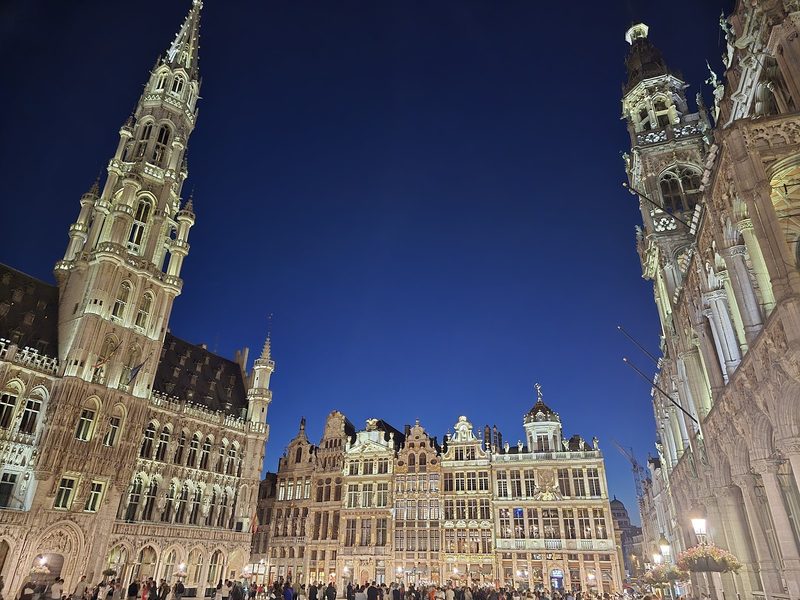
Grand Place is the city's best-known landmark. A UNESCO World Heritage Site, it is the square Victor Hugo described as "the most beautiful square in the world". Surrounded by 17th-century Baroque façades, it takes on a different appearance when lit at night. But the city extends beyond Grand Place: Magritte's Surrealist paintings, its role as the birthplace of Art Nouveau architecture (Victor Horta worked here), the comic-book culture behind Tintin and the Smurfs, and more than 50 giant street murals give it many layers.
Brussels has a culinary heritage outsized for its population. Moules-frites (mussels with fries) is considered the national dish, waffles are a street snack, and praline chocolate was invented here (Neuhaus, 1912). Although the origin of fries is disputed, Belgians defend them as their own invention. Beer culture is on UNESCO's Intangible Cultural Heritage list.
Belgian beer deserves a section of its own. More than 1,500 varieties are produced in the country: Trappist monks' beers, spontaneously fermented lambic, witbier, dubbel, tripel and quadrupel. Brussels is particularly the birthplace of lambic; gueuze and kriek (sour-cherry lambic) originated here. Delirium Café's menu of more than 2,000 beers has entered the Guinness Book of Records.
Around 3 hours by air from Türkiye, the city suits a long-weekend break. Flying out on Friday morning and returning Monday evening can allow 3 full days in Brussels and, if desired, a day in Bruges or Ghent. The city is compact and walkable, with functional public transport. It is more affordable than Paris and Amsterdam, but more expensive than Prague and Budapest.
When to visit
Brussels has an oceanic climate, with rain possible in every month. Bring an umbrella and do not rely too heavily on the weather forecast.
| Period | Weather (daytime) | Density | Otel Fiyatı | Notes |
|---|---|---|---|---|
| January-February | 1 / 6° | Low | Low | Cold, gray but cheap. Museum and cafe days |
| March | 3 / 10° | Low | Low | Spring is blooming, still cold |
| April | 5 / 14° | Medium | Medium | The parks are blooming, the days are getting longer |
| May | 9 / 18° | Medium-High | Medium | One of the most beautiful months, Zinneke Parade |
| June | 12 / 21° | High | High | Long days, outdoor activities |
| July | 14 / 23° | High | High | Tomorrowland season, hotel prices are jumping |
| August | 14 / 23° | High | High | Flower Carpet (in even years), Summer Festival |
| September | 11 / 19° | Medium-High | Medium | Second best period, the crowds are thinning |
| October | 8 / 14° | Medium | Medium | Autumn colors, beer festivals |
| November | 4 / 9° | Low-Medium | Low-Medium | Christmas markets open at the end of November |
| December | 2 / 6° | High | High | Plaisirs d'Hiver Christmas markets are magical |
The best times are May–June and September. In even-numbered years, August has the added attraction of the Flower Carpet. Christmas markets bring atmosphere in December, but the weather is cold and crowds are large. Rain is possible in Brussels in every season; a folding umbrella should be a permanent part of your travel bag.
Getting there
Brussels' main airport, Brussels Airport (BRU), is 12 km northeast of the city centre. A second airport, Brussels South Charleroi (CRL), is used for low-cost airlines but is 60 km away from the city.
Flights from Türkiye:
| Exit | Duration | Airline |
|---|---|---|
| Istanbul (IST) - BRU | 3 hours 15 min | THY, Brussels Airlines (3-4 flights per day) |
| Istanbul (SAW) - CRL | 3 hours 20 min | Pegasus (1-2 times a day) |
| Ankara (ESB) - BRU | 3 hours 30 min | THY (3-4 flights per week) |
| Izmir (ADB) - BRU | 3 hours 25 min | THY, Pegasus (2-3 times a week) |
Pegasus flights usually land at Charleroi; check the airport code before booking. A 1-hour bus connection links Charleroi with the centre. Turkish Airlines and Brussels Airlines fly directly into BRU.
Airport to city (BRU):
- Train: 17 min, Bruxelles-Midi / Bruxelles-Central, 14.70 EUR. The fastest option.
- Airport bus: 30-40 min, various points, 6 EUR (STIB/De Lijn).
- Taxi/Uber: 20-30 min, 35-50 EUR fixed fee depending on the region.
From Charleroi (CRL):
- Brussels City Shuttle: 60 min, Bruxelles-Midi, 17 EUR one way. It works according to flight times.
The most practical route is to fly into BRU with Turkish Airlines or Brussels Airlines and take the train to the centre. If you find a cheap fare to Charleroi, add the shuttle cost to the total; sometimes the two options end up close in price.
Train option: On the Thalys/Eurostar network, Paris is 1 hour 22 minutes away, Amsterdam 1 hour 53 minutes and Cologne 1 hour 50 minutes. Brussels is a crossroads of Europe's high-speed rail network; London is 2 hours away by Eurostar. Bruges is 1 hour away, and Ghent 35 minutes.
Urban Transportation
Brussels is compact and its centre can be explored on foot, but the steep gradient between the upper and lower city makes public transport useful.
Metro: 4 lines (1, 2, 5 and 6) provide adequate coverage, running from 05:30 to 00:30.
Tram: 18 lines reach areas not served by the metro. Useful for neighbourhoods such as Ixelles and Schaerbeek.
Bus: Fills the gaps in the metro and tram networks; night services are limited.
Ticket system (STIB/MIVB): One way 2.40 EUR (with MOBIB card), paper ticket 2.50 EUR. 24 hour pass 8 EUR, 48 hour 14 EUR, 72 hour 18 EUR. Tickets are valid on metro, tram and bus.
Brussels Card: Available for 24/48/72 hours (30/42/52 EUR), including free admission to more than 40 museums and public transport. It pays for itself with a busy museum itinerary.
Bicycles (Villo!): A station-based bike-share system. Costs 1.60 EUR per day, with the first 30 minutes free. Some of the city's hills are steep, so choose your route carefully.
Taxi/Uber: Uber and Bolt operate here; short trips within the city cost 8–15 EUR.
Accommodation Regions
Where to stay in Brussels depends on your travel style; the centre itself covers a compact area.
- Around Grand Place (Ilot Sacré): Everything is within walking distance, but this is the most expensive area. Tourist numbers are high; some restaurants on Rue des Bouchers are known for touting at the door, so avoiding this street makes sense.
- Sainte-Catherine: Fish restaurants, bars and local life together. A 10-minute walk from Grand Place, with prices 20–30% below those in the centre.
- Saint-Géry / Dansaert: A nightlife hub with boutique hotels and design shops. Noise levels rise on Friday and Saturday nights.
- Ixelles / Place Flagey: A residential Brussels neighbourhood near the EU district, with a cosmopolitan character. It has Art Nouveau buildings, independent cafés and ponds. Prices are reasonable, and the centre is 10–15 minutes away by tram.
- EU District (Schuman / Luxembourg): Busy with business travellers on weekdays and quiet on weekends. Hotels may offer weekend discounts, but nightlife is almost nonexistent.
Areas not recommended: Around Bruxelles-Midi (South Station) requires care at night for safety reasons and has no tourist appeal. Molenbeek likewise offers no particular reason for a tourist visit.
Budget Plan
Brussels is a mid-budget city by Western European standards: more affordable than Amsterdam and Paris, but more expensive than Prague and Budapest.
| Budget Style | Accommodation | Food | Activity/Transportation | Total (2 people/3 days) |
|---|---|---|---|---|
| Economic (hostel/2* hotel, friture + 1 restaurant) | 200 EUR | 120 EUR | 60 EUR | ~400 EUR |
| Moderate (3* hotel Sainte-Catherine, mixed) | 400 EUR | 220 EUR | 100 EUR | ~750 EUR |
| Comfort (4* boutique hotel, gastronomy) | 800 EUR | 380 EUR | 150 EUR | ~1.350 EUR |
| Luxury (5* Amigo/Steigenberger, fine dining) | 2,000 EUR+ | 800 EUR+ | 250 EUR | ~3,050 EUR+ |
Practical items: Waffles 4-8 EUR, french fries 3.50-6 EUR, moules-frites 20-28 EUR in the restaurant, 4-8 EUR in the beer bar, hot chocolate 5-7 EUR, praline box 15-40 EUR, museum entrance average 10-16 EUR, metro 8 EUR per day, beer 5-10 EUR in Delirium.
Practical Tips
Rain: Brussels records an average of 200 rainy days per year. Always keep a folding umbrella and waterproof jacket in your bag, even when the forecast looks sunny.
Language: Brussels is officially bilingual (French and Dutch), but French dominates daily life. Greeting people with "Bonjour" and thanking them with "merci" is enough; English can handle the rest.
Tipping: Service is already included in the bill (service compris). An extra tip is not compulsory, but leaving 5–10% is common.
Sundays: Most shops close, while restaurants and museums stay open. The Marolles flea market also runs on Sundays; plan regular shopping for weekdays or Saturday.
Safety: Brussels is generally considered safe, but pickpocketing is reported in tourist areas around Grand Place. Take care around Bruxelles-Midi station and in Anneessens at night.
Buying chocolate: Choosing producer-chocolatiers such as Marcolini, Neuhaus, Wittamer, Mary or Laurent Gerbaud over tourist shops brings a clear improvement in quality for a small difference in price. Galeries Royales and Grand Sablon have the highest concentration of chocolate shops.
Beer guide: A progression for newcomers to Belgian beer: Witbier (light, wheat-based) → Dubbel (dark, caramel notes) → Tripel (strong, fruity) → Lambic/Gueuze (sour). At Delirium, telling the staff your preferences makes it easier to get recommendations.
Bruges and Ghent: Both are within day-trip distance of Brussels: Bruges is a 1-hour train journey and Ghent 35 minutes. Bruges is more tourist-oriented and retains its medieval character, while Ghent has a more local atmosphere.
Water: Tap water is drinkable. Ordering bottled water is the norm in restaurants; you can ask for "eau du robinet" (tap water), though not every waiter may respond equally promptly.
Travel Guide with Children
Brussels offers families with children more options than expected. Mini-Europe, the Atomium and comic-book culture provide activities for different age groups.
Recommendations by Age Group
Ages 0–3: Cinquantenaire Park is suitable for pushchairs thanks to its spacious, flat grounds. The metro has lifts, though not at every station; trams have low floors. Baby-care rooms are standard in shopping centres and museums.
Ages 4–7: At Mini-Europe, pressing buttons makes volcanoes erupt and ships move. Walking through the Atomium's tubes feels like an adventure at this age. The story of Manneken Pis' costumes entertains children.
Ages 8–12: The interactive sections at the Comic Strip Centre draw interest. Following the city's murals with a map turns into a treasure hunt. Autoworld, the classic car museum in Cinquantenaire, suits children interested in vehicles.
Ages 13+: The history behind Grand Place, the Surrealist world of the Magritte Museum, a street-food tour and comic-book shops appeal to teenagers.
Top 5 Kid-Friendly Activities
Mini-Europe — 350 miniature European monuments, interactive models, switches and buttons. It can be visited on the same day as the Atomium with a combined ticket.
Atomium — Walk through an iron crystal structure and its tubes, then admire the view from the highest sphere. Children's ticket: 8.50 EUR.
Comic Strip Centre + mural hunt — Statues of Tintin, the Smurfs and Lucky Luke, plus interactive sections. After the museum, you can follow the city's murals using a map.
Cinquantenaire Park + Autoworld — Spacious parkland and more than 250 classic cars at Autoworld. The Military History Museum is free, with a notable rooftop aircraft collection.
Waffle tour — Brussels waffles at Dandoy, Liège waffles from a street stall and tastings in chocolate shops. Introducing the city through food is a practical approach with children.
Practical Information
Pushchairs: Brussels' sloping streets and cobblestones can be challenging; choose a lightweight, manoeuvrable model. The metro has lifts, but not at every station; check accessibility information in the STIB app.
Children's menus: Children's portions are common in Belgian restaurants. Waffles, fries and Belgian meatballs (boulettes) are popular with children.
Children's ticket discounts: On the metro and buses, under-6s travel free and ages 6–11 pay half price. Most museums offer reduced or free entry to under-18s. A family version of the Brussels Card is available.
Toilets: Available in museums, shopping centres and cafés. Public street toilets are limited in number; those charging 0.50 EUR are well maintained.
Warnings
- Cobblestone streets become slippery when wet; children should wear shoes with non-slip soles.
- Crowds can build up in the narrow streets around Grand Place; keep small children in sight.
- Chocolate-shop tastings are tempting, but limiting the amount helps protect children's stomachs.
- A day trip to Bruges is possible with children, but long walks can be tiring; a canal tour offers an alternative.
Local Label and Culture Notes
Belgians are reserved but warm on first meeting, neither as theatrical as the French nor as direct as the Dutch. Shaking hands is standard when introduced; in familiar settings, people exchange three cheek kisses, starting on the right, but a handshake is sufficient for a tourist.
Language sensitivity: French dominates Brussels, but language is a political issue in Belgium. Avoid commenting on the language balance when talking to a Flemish person. Starting with "Bonjour", then switching if the other person replies in Dutch or moving to English, is a practical approach.
Beer culture: Belgian beer is taken seriously. Each beer has its own glass, and serving it in the wrong one is not expected. Waiters know their beer recommendations; describing your taste brings better suggestions than asking "which beer is best?".
Fries: Calling them "French fries" can provoke a local reaction; Belgians maintain that fries are their invention. "Frites" or "frieten" is preferred. They come with mayonnaise; ketchup is uncommon.
Punctuality: Belgians are not as strict as Germans, but lateness is frowned upon; arrive on time for appointments.
Quiet and noise: Keeping your voice down on public transport and speaking at a normal volume in restaurants fits local norms.
Tourist traps: Rue des Bouchers, near Grand Place, is known for some restaurants touting at the door; the bill may differ from menu prices. Moving one street away generally offers better options.
Chocolate etiquette: Belgians are selective about chocolate. Leonidas and Godiva are seen as supermarket quality; producer brands such as Marcolini, Wittamer, Mary and Laurent Gerbaud are held in higher regard.
FAQ
How many days to visit Brussels? Two or three days are enough for the city's main sights. With five days, you can add day trips to Bruges and Ghent. A week allows a slower pace for neighbourhood exploration and a beer tour.
Is English sufficient? Yes. As the EU capital, Brussels uses English almost as a third common language. Communication is straightforward in hotels, museums, restaurants and on public transport. Knowing "Bonjour", "merci" and "s'il vous plaît" is polite, but not essential.
Brussels or Bruges? They offer different experiences. Brussels has museums, nightlife and gastronomy on a big-city scale; Bruges is a small medieval city. Since Bruges is only 1 hour from Brussels, combining them is easier than choosing one.
Where to buy chocolate? The chocolatiers in Grand Sablon stand out. Pierre Marcolini, Wittamer, Patrick Roger and Laurent Gerbaud are producer-quality brands. Neuhaus is known as the brand that invented the praline. The shops in Galeries Royales are another option. Gift boxes of pralines cost around 15–25 EUR per person.
How to discover Belgian beer? Asking a waiter at Delirium Café or Moeder Lambic for recommendations works well. You can move from lighter to stronger: Witbier (Hoegaarden style) → Blonde (Leffe Blonde) → Dubbel (Westmalle Dubbel) → Tripel (Tripel Karmeliet) → Lambic/Gueuze (Cantillon). It makes sense to sample a small amount of each, then choose your favourite.
How to get to Bruges and Ghent? Both are reached by train from Bruxelles-Midi or Bruxelles-Central. Bruges takes 1 hour, with a return fare of 15 EUR. Ghent takes 35 minutes, with a return fare of 10 EUR. Trains run frequently, so there is no need to buy tickets in advance.
Why are french fries so good They use a double-frying technique: potatoes are first cooked at a low temperature and left to rest, then fried again at a high temperature. The result is crisp outside and soft inside. Those fried in beef fat are generally considered better. They come with mayonnaise, rather than ketchup.
How to buy Tomorrowland tickets? Tickets usually go on sale in February and sell out quickly. Pre-registration on the official website is required. Global Journey packages (transport + ticket) are easier to find but expensive. You can also use Brussels as a base and make a day trip to Boom by train and shuttle.
Are there Turkish food options in Brussels? Yes. Schaerbeek and Saint-Josse have a high concentration of Turkish restaurants. Döner, pide and lahmacun can be found along Chaussée de Haecht. Brussels has a large Turkish community, so you may also meet someone who speaks Turkish.